
Nut Diameter Chart
Which wrench fits a 3/8-inch nut? What is the thread pitch of an M8 bolt? This printable pack answers both with inch and metric hex nut charts — bolt diameter, wrench size across flats, nut thickness and threads — plus an actual-size bolt gauge you can hold a bolt against, and an Excel lookup sheet for the workshop.
- Instant download
- Editable Excel
- Print-ready PDF
- 7-day refund
5 files · PDF, XLSX
Nut & Bolt Size Chart Pack
Printable inch and metric hex nut charts (wrench size, thickness, threads), an actual-size bolt diameter gauge, a bolt grade marking chart and an Excel fastener lookup.
- Inch nut chart (PDF/XLSX)
- Metric nut chart (PDF/XLSX)
- Bolt gauge (PDF)
- + 2 more
$5.00 USD, one-time 5 files · about $1.00 each
- Instant download
- 7-day refund
- Secure checkout by Stripe
7-day money-back guarantee. Full refund within 7 days of purchase, even after you download.
Free sample: Inch Hex Nut Chart (PDF, 57 KB)
Nut & Bolt Size Chart Pack
Printable inch and metric hex nut charts (wrench size, thickness, threads), an actual-size bolt diameter gauge, a bolt grade marking chart and an Excel fastener lookup.
- Inch nut chart (PDF/XLSX)
- Metric nut chart (PDF/XLSX)
- Bolt gauge (PDF)
- Grade chart (PDF)
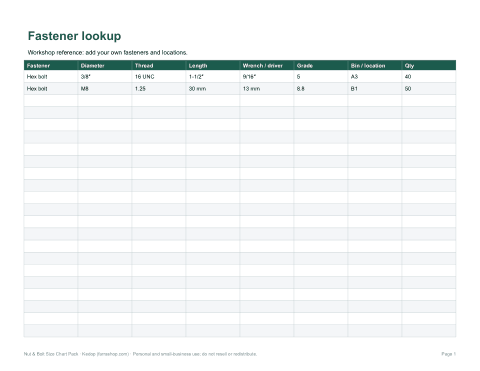
- Fastener lookup (XLSX)
Formats: PDF, XLSX. Instant download after payment (link valid 72 hours, up to 5 downloads). AI-assisted: the templates were drafted with AI help and reviewed and laid out before publishing.
$5.00 USD, one-time 5 files · about $1.00 each
- Instant download
- 7-day refund
- Secure checkout by Stripe
7-day money-back guarantee. Full refund within 7 days of purchase, even after you download.
Free sample: Inch Hex Nut Chart (PDF, 57 KB)
Full refund within 7 days — see the refund policy and license.
Free printables
Single sheets you can print right now, no sign-up. The full pack adds every sheet in one download plus the editable files.
 Printable Inch Nut Diameter Chart
 Printable Metric Nut Size Chart
 Printable Bolt Diameter Gauge
 Printable Grade Chart
 Printable Fastener Lookup Sheet
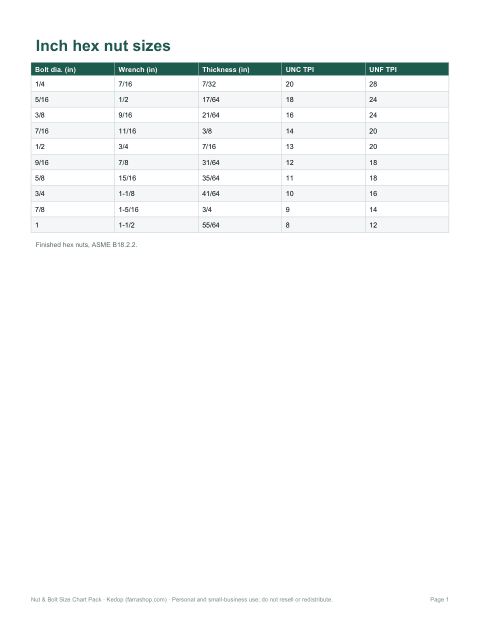
Inch hex nut chart (finished hex nuts)
| Bolt diameter (in) | Wrench size (in) | Nut thickness (in) | UNC threads/in | UNF threads/in |
|---|---|---|---|---|
| 1/4 | 7/16 | 7/32 | 20 | 28 |
| 5/16 | 1/2 | 17/64 | 18 | 24 |
| 3/8 | 9/16 | 21/64 | 16 | 24 |
| 7/16 | 11/16 | 3/8 | 14 | 20 |
| 1/2 | 3/4 | 7/16 | 13 | 20 |
| 9/16 | 7/8 | 31/64 | 12 | 18 |
| 5/8 | 15/16 | 35/64 | 11 | 18 |
| 3/4 | 1-1/8 | 41/64 | 10 | 16 |
| 7/8 | 1-5/16 | 3/4 | 9 | 14 |
| 1 | 1-1/2 | 55/64 | 8 | 12 |
Dimensions for standard finished hex nuts (ASME B18.2.2). Heavy hex and jam nuts have different widths or thicknesses.
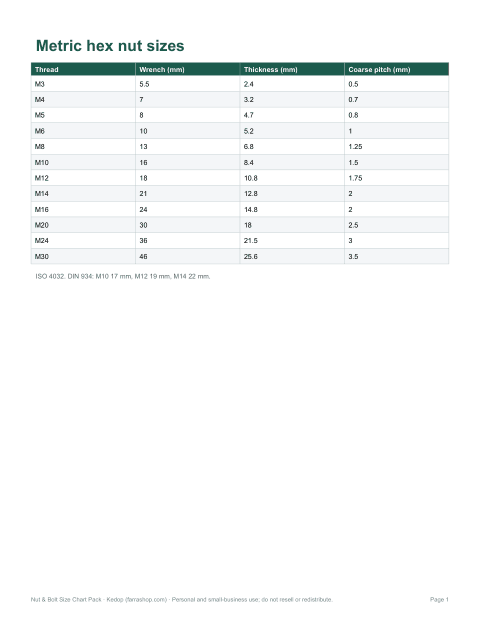
Metric hex nut chart
| Thread | Wrench size (mm) | Nut thickness (mm) | Coarse pitch (mm) |
|---|---|---|---|
| M3 | 5.5 | 2.4 | 0.5 |
| M4 | 7 | 3.2 | 0.7 |
| M5 | 8 | 4.7 | 0.8 |
| M6 | 10 | 5.2 | 1 |
| M8 | 13 | 6.8 | 1.25 |
| M10 | 16 | 8.4 | 1.5 |
| M12 | 18 | 10.8 | 1.75 |
| M14 | 21 | 12.8 | 2 |
| M16 | 24 | 14.8 | 2 |
| M20 | 30 | 18.0 | 2.5 |
| M24 | 36 | 21.5 | 3 |
| M30 | 46 | 25.6 | 3.5 |
Wrench sizes follow ISO 4032. Some older DIN 934 nuts use different sizes: M10 = 17 mm, M12 = 19 mm, M14 = 22 mm.
Nut size vs wrench size
A nut is named by the diameter of the bolt it fits, not by its own outside size. A 1/2-inch nut fits a 1/2-inch bolt and takes a 3/4-inch wrench; an M8 nut fits an 8 mm bolt and takes a 13 mm wrench. The wrench size is the distance across the flats of the hexagon. When a nut is labelled only with a wrench size, use the chart in reverse to find the bolt diameter.
Coarse vs fine threads
| Thread | Pros | Typical uses |
|---|---|---|
| UNC / metric coarse | Faster to assemble, less likely to cross-thread, better in soft materials | General construction, machinery, most hardware |
| UNF / metric fine | Greater tensile strength, finer adjustment, less likely to loosen under vibration | Automotive, aerospace, precision equipment |
A nut must match both the diameter and the thread pitch of its bolt. Use a thread pitch gauge or compare with a known bolt if you are not sure.
How to measure a bolt
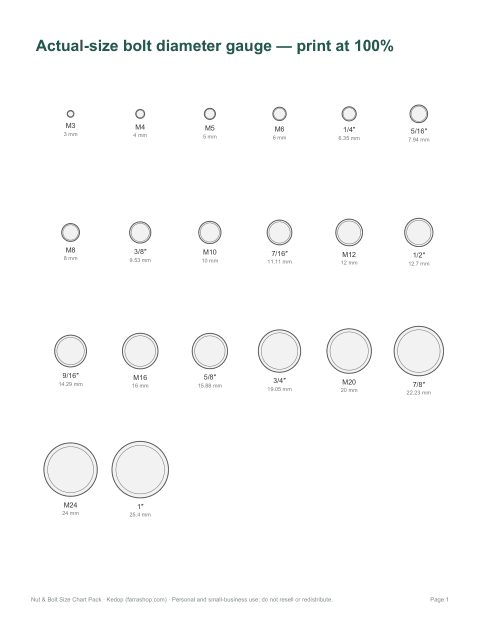
- Measure the outside diameter of the threads with calipers (or use the actual-size gauge sheet).
- Count threads per inch, or measure pitch in mm between adjacent threads.
- Measure length from under the head to the tip (for flat-head screws, the overall length).
- Identify the grade marking on the head for strength.
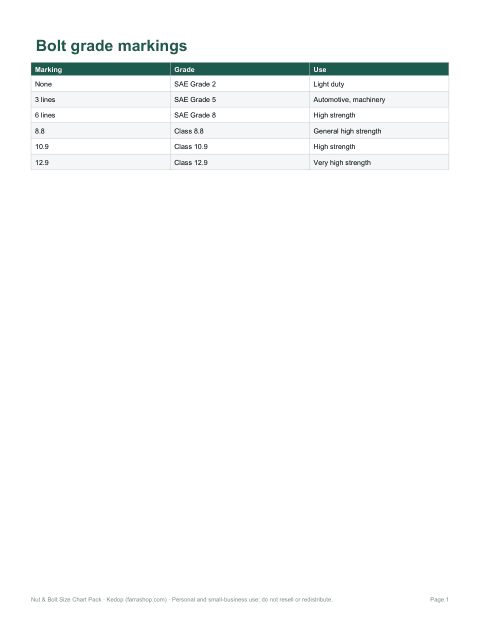
Bolt grade markings
| Marking | Grade | Typical use |
|---|---|---|
| No marks (inch) | Grade 2 | Light-duty |
| 3 radial lines | SAE Grade 5 | Automotive, general machinery |
| 6 radial lines | SAE Grade 8 | High-strength applications |
| 8.8 (metric) | Property class 8.8 | General high-strength |
| 10.9 (metric) | Property class 10.9 | High-strength automotive |
| 12.9 (metric) | Property class 12.9 | Very high strength |
Use nuts of matching or higher grade than the bolt.
What is in the pack
- Inch hex nut chart with wrench size, thickness and UNC/UNF threads.
- Metric hex nut chart with wrench size, thickness and coarse pitch.
- Actual-size bolt diameter gauge (print at 100%).
- Bolt grade marking chart.
- Excel fastener lookup with wrench sizes and tap drill notes.
Formats
Print-ready PDF charts and gauge (US Letter; A4 at 100%), plus an Excel lookup workbook.
Frequently asked questions
What size wrench for a 3/8 bolt?
9/16 inch for a standard 3/8-inch hex nut.
What size wrench for an M8 nut?
13 mm.
What is the thread pitch of M10?
1.5 mm coarse (1.25 mm fine).
Is a 1/2 inch nut 1/2 inch wide?
No — it fits a 1/2-inch bolt and is 3/4 inch across the flats.
Was AI used to create the charts?
The charts were generated by script from standard dimensions and text drafted with AI assistance, then reviewed before publishing.